Comparison of different methods of soil respiration measurement in field conditions
DOI:
https://doi.org/10.31251/pos.v9i3.369Keywords:
soil CO2 emission; chamber method; absorption method; components of soil respiration; carbon balance in soil.Abstract
The aim of the study was to provide a comparative assessment of the average daily intensity of soil respiration (soil CO2 emission rate in field conditions) using three methods, including two modifications of the chamber method and an absorption method.
Location and time of the study. The study was carried out in 2024–2025 in the grass and forest biogeocenoses located in the suburbs of Novosibirsk (Akademgorodok area, 54°85′09′′ N, 83°18′34′′ E). The soil is a dark gray forest soil of medium loamy granulometric composition (Luvic Greyzemic Phaeozem (Siltic)).
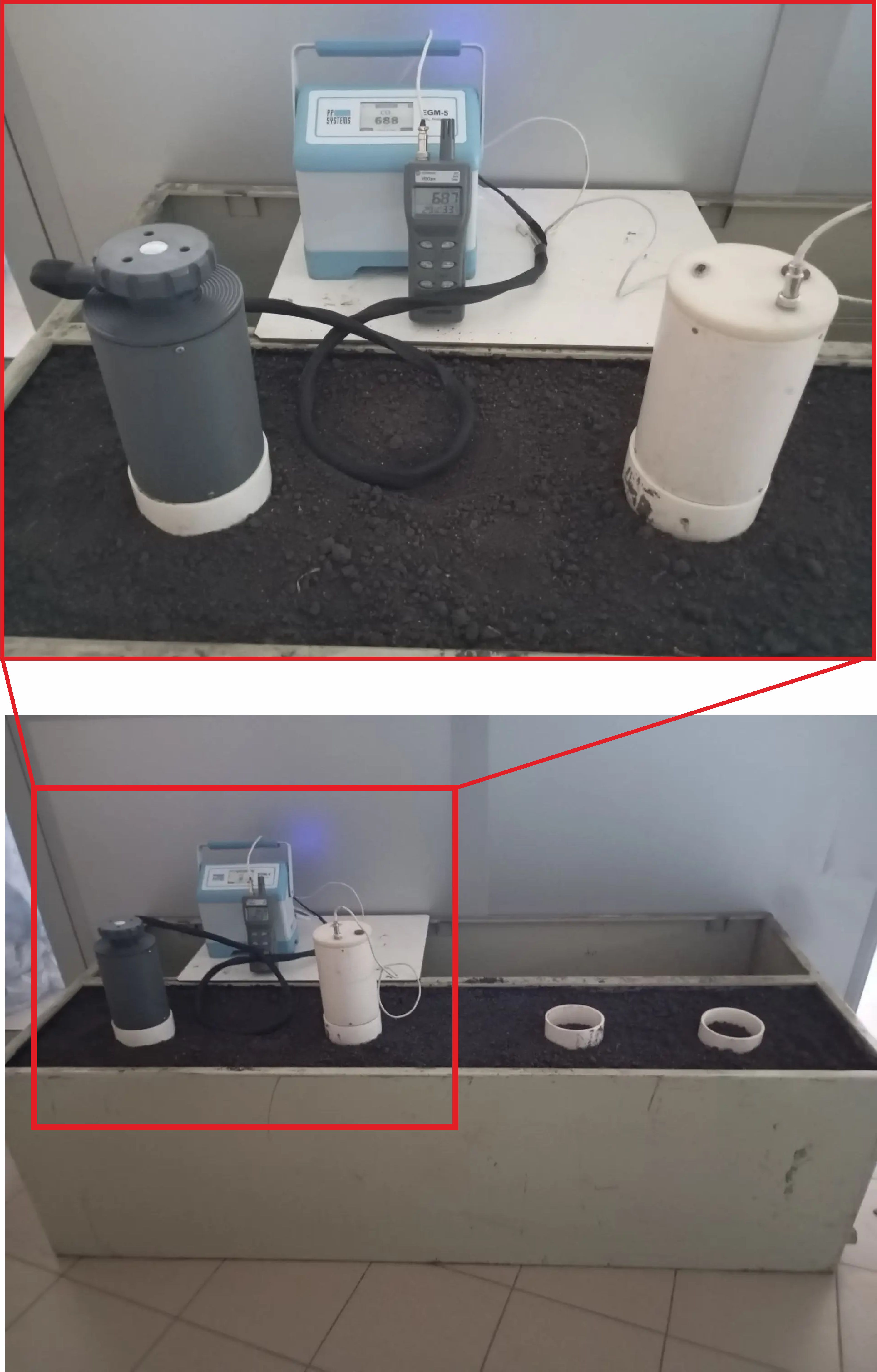
Methods. Carbon dioxide emission from soil was measured by three methods. Two of them were modifications of the chamber method, and the third one was an improved version of the absorption method. In the dynamic version of the chamber method (hereinafter referred to as the EGM-5 method), the CO2 concentration in the chamber air was determined using a high-precision (<1%) IR gas analyzer. In the static modification (the VENTpro method), the CO2 concentration was determined using an inexpensive but less accurate (±5%) analog. In the absorption method, the soil was covered with an insulating vessel for 24 hours, and the emitted CO2 was absorbed by 10 ml of a 1 M NaOH solution with a sorption surface equal to 38 % of the isolated soil area.
Results. In the model experiment in which spatial variability in soil biological activity was minimized, a decrease in the CO2 flux was registered by chamber methods due to CO2 accumulation in the above-ground space of the chambers. Ten minutes after chamber sealing, the CO2 flux was 4–7% for the EGM-5 method and 9–10% for the VENTpro method. Moreover, the coefficient of variation for CO2 emission from soil in this experiment was 8% for the EGM-5 method and 16% for the VENTpro method. It is concluded that with the respiration measurement procedure in which the chamber was sealed for only 5 minutes, a decrease in the natural rate of CO2 diffusion from soil did not significantly affect the results. When measuring soil respiration in the field at small plots (≈10 m2), the coefficient of variation of the average daily soil CO2 emission rate increased to 20% or more when registered by the chamber methods, whereas it did not exceed 10% by the absorption method. Due to the significant variability, the differences between the results of the three methods were not statistically significant. For this reason, it was also not possible to identify significant differences in the dynamics of soil CO2 emission during the day in the forest and grassland biogeocoenoses. All three methods provided fairly close results for the total CO2 emission for May–October (kg C-CO2 /ha): 5674 by EGM-5, 6347 by VENTpro and absorption 6198 (LSD05 = 607).
Conclusions. In most cases, when comparing soil respiration in the field, no statistically significant differences were found between the results of the three methods, although the differences often reached 30% or more. This is because of the high variability of soil CO2 emission rate, especially observed when measured with the VENTpro device, which was largely due to the large spatial variability of soil biological activity in the forest and grassland. To record more subtle effects using chamber methods (for example, intra-daily respiration dynamics), a preliminary assessment of the variability of the CO2 emission indicator at the experimental plot and the calculation of the required measurement replication rate are indispensable. It is also important to conduct detailed studies of possible errors in calculating the average daily soil CO2 emission rate using chamber methods based on its current actual value (determined over 1–5 minutes of exposure). Apparently, under certain conditions, mainly with weak soil temperature dynamics during the day, these errors will be insignificant. The absorption method used in this study avoided this drawback as it measured soil respiration over a 24-hour exposure period. In our opinion, until a generally accepted method for determining the average daily soil CO2 emission rate is established, the choice of method should be based on the purpose and feasibility of the study. The anticipated quantitative differences in soil CO2 emissions, which are expected to be identified as a result of such a study, should be of key importance.
Downloads
Downloads
Published
How to Cite
Issue
Section
License
Copyright (c) 2026 The Journal of Soils and Environment

This work is licensed under a Creative Commons Attribution 4.0 International License.