Changes in the chemical composition of plant litter during decomposition in an oligotrophic peatland
DOI:
https://doi.org/10.31251/pos.v8i4.344Keywords:
peatlands; peat-forming plants; West Siberia; decomposition rate; mineral composition.Abstract
The aim of the study was to assess the influence of the plant litter type on the organic matter transformation rate and the release of macro- and microelements.
Location and time of the study. The study was conducted from 2008 to 2012 on the territory of the oligotrophic peatlands "Bakcharskoye" (Bakcharsky district of Tomsk region) in a pine-shrub-sphagnum phytocenosis (Low ryam) (56°58'34,10" N 82°36'27,48" E).
Methods. The plant residues decomposition rate was determined by the litterbag method. Carbon and nitrogen contents, as well as ash content, were determined in the initial and post-experiment samples. The elemental composition of plant residue ash was determined using a HITACHI-S-3400N electron microscope with an X-ray spectral analyzer.
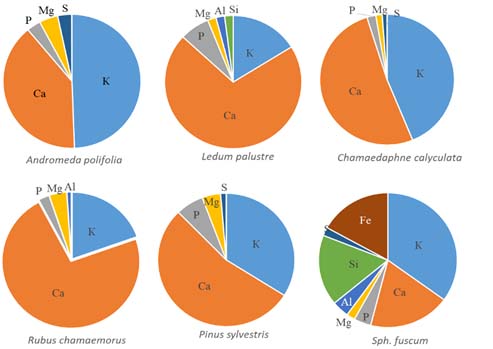
Results. The mass loss of the studied plant samples revealed that the decomposition processes were most intensive at the initial stage of decomposition during the first 12 months, afterwards the decomposition rate significantly decreasing. During the first year of plant residues decomposition, nitrogen immobilization generally occurred in all plant samples. However, by the end of the experiment, nitrogen loss was observed in all samples, with the exception of Sphagnum fuscum, for which a 5% increase in nitrogen content was observed. As a result of the mineralization of organic matter in plant litter, ash content decreased, also with the exception of Sph. fuscum, for which a slight increase of 1,1 times was revealed. The ash of the studied plants contained a number of elements, including K, Ca, P, Mg, Al, Si, S, Fe, and others, with K and Ca being the major components. During decomposition the ash content changed: a sharp decrease in K (by 1,6–7,9 times) and Ca (by 2,2–7,1 times) took place in all samples except for Sph. fuscum. All samples also showed accumulation of iron, aluminum, and silicon. Phosphorus content was found to increase in all samples except Sph. fuscum.
Conclusions. During decomposition, carbon depletion was found in all plant residues, with the dynamics of carbon loss strictly corresponding to the mass loss of organic matter. Nitrogen loss was revealed in all samples, except Sph. fuscum. The ash content of plant residues decreased by 1,2–1,9 times, with the exception of Sph. fuscum, for which a slight increase in ash content was found. The latter may be due to the accumulation of ash elements in the plant residues of Sph. fuscum, in combination with the low rate of organic matter mass loss. During the plant residues decomposition the leaching of K and Ca, and accumulation of Fe, Al, Si, P occured in all the studied samples. The identified dynamics pattern of the elemental content during the decomposition of plant residues provided a better insight into the specifics of destruction of each peat-forming plant species in the pine-shrub-sphagnum biogeocenoses of the Bakchar bog.
Downloads
Downloads
Published
How to Cite
Issue
Section
License
Copyright (c) 2025 The Journal of Soils and Environment

This work is licensed under a Creative Commons Attribution 4.0 International License.