Rhizosphere bacteriobiome and tomato production under mineral fertilization in the open field in the south of West Siberia
DOI:
https://doi.org/10.31251/pos.v8i3.336Keywords:
Phaeozem; mineral fertilization; tomato; 16S-metabarcoding; soil ecological conditions.Abstract
The aim of the study was to investigate the effect of mineral fertilization on the production properties of tomato plants and diversity of their rhizosphere bacteriobiome along a gradient of soil-ecological properties on four experimental sites, located in the forest-steppe zone of West Siberia.
Location and time of the study. The microplot field experiment for growing tomato Licopersicon esculentum Mill. Of Zyryanka cultivar was performed on four experimental sites with agrogrey soils (Phaeozems) in the Novosibirsk Region in 2021. Two treatments each ted three times were used: no fertilization (No) and mineral fertilization (NPK) at the rate of N60P60K60. The geographical coordinates of the experimental sites ranged 55°15'40 – 54°47'09 NL and 83°31'42 – 82º37' 56 EL.
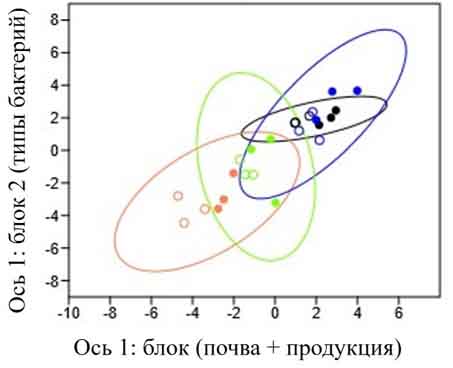
Methodology. The experiment was performed with the similar setup simultaneously on four experimental fields in order to substitute temporal gradient with a spatial one, which allowed to estimate the effect of weather and soil properties variation on the variables of interest in the study. Soil samples were collected prior to the start and at the completion of the experiment and analyzed for soil organic, nitrates, mobile phosphorus, exchangeable potassium, calcium and magnesium content, as well as pH. Air and soil temperature was recorded during the experiment. At the end of the experiment tomato fruit number and mass, as well as above – and below ground phytomass were determined on each plot. The composition and structure of the rhizosphere soil bacteriobiome was estimated by 16S-metabarcoding. Statistical analysis was performed by using analysis of variance, principal components extraction and two-blocks multiple regression by partial least squares with the help of Statistica v.13.1 and PAST v. 4.16.
Main results. Overall, tomato rhizosphere was found to have 7935 operational taxonomic units, the majority of them (more than 45% of species' richness) belonging to Pseudomonadota. The Actinomycetota phylum was the ultimate dominant in the sequence reads relative abundance with ≥33%. Other major dominants with relative abundance of >10% were Pseudomonadota, Bacillota and Acidobacteriota. Mineral fertilization increased Actinomycetota abundance by 15%. Some dominant genera changed increased (Pseudarthrobacter, Streptomyces), whereas the other (dominant genus-level clusters from Acidobacteria_Gp6, Hyphomicrobiales, Myxococcales and Iamiaceae) decreased their relative abundance due to the NPK fertilization. Altogether, 252 of 880 genera detected in the study, had their abundance changed by NPK fertilization, but except six dominants, they were minor or rare. Although slightly, but fertilization decreased alpha-biodiversity indices of Shannon and Simpson, somewhat increasing Berger-Parker and D-Simpson indices. The latter tended to correlate positively with tomato production characteristics, whereas Shannon and Simpson tended to correlate with soil properties. As averaged over four experimental sites, mineral fertilization improved tomato production characteristics (fruit number and mass, above- and belowground phytomass) that showed no correlation with soil properties before the experiment.
Conclusions. Bacteriobiome of tomato rhizosphere soil, being a dynamic entity, can change due to the influence of various factors, including mineral fertilization at the moderate rate. This provides the potential for targeted modification of rhizosphere bacteriobiome in particular and agromicrobiome as a whole to benefit the growth and development of agricultural plants. With climate warming and increasing of the frost-free period in the south of West Siberia small- medium-size tomato production in the open field is perspective even under moderate fertilization. Understanding the effect of such fertilization on agromicrobiome and production properties of crops can help sustaining soils and crops health and hence the quality of produced yields.
Downloads
Downloads
Published
How to Cite
Issue
Section
License
Copyright (c) 2025 The Journal of Soils and Environment

This work is licensed under a Creative Commons Attribution 4.0 International License.