Integral diagnostics of grey soils and their transformation during agropedogenesis
DOI:
https://doi.org/10.31251/pos.v9i1.330Keywords:
spatial variability; grey soils (Haplic Greyzems); agropedogenesis; physicochemical properties; soil electrical resistance; virgin land; arable land.Abstract
The aim of the study. Integrated diagnostics of grey soils, as well as transformation of their properties during agrogenic use.
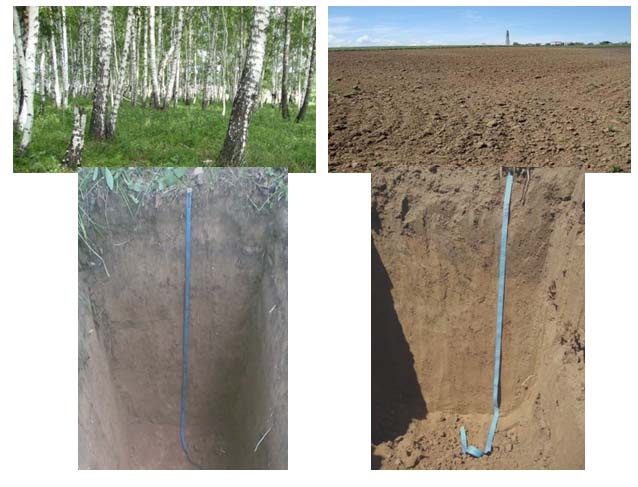
Location and time of the study. Soils located at the teaching farm "Molodezhny" of the Irkutsk State Agrarian University named after A.A. Ezhevsky were the objects of the study.
Methods. The morphological description of soil profiles was performed. Determination of particle size distribution, organic matter content, macroelement composition using X-ray fluorescence analysis, group composition of iron, indicators of agrochemical properties were used in the study. Measurements of specific electrical resistance using the LandMapper-03 device were also carried out.
Results. The obtained data indicated a drastic transformation of the soil profile under the influence of agrogenic factors: homogenization of the upper horizons and simplification of the profile, a sharp decrease in humus and exchangeable cations content, acidification of the arable horizon of the agrosoil and heavier granulometric composition. The crystallized forms of iron prevailed among its non-silicate forms. X-ray fluorescence analysis showed that in arable soils there was a redistribution of bulk chemical elements, especially in sesquioxides with a decrease in the silica content. Agrogenic processes contributed to decreasing the difference in chemical composition and horizon differentiation and increasing homogeneity. The content of the mobile forms of nutrients revealed a decrease in the nitrate nitrogen and phosphorus in the arable horizons, which may indicate nutrients deficiency and imbalance. Measurements of the stationary electrical resistance of soils (SER) showed its dependence on the content of silt, humus and sesquioxides. In arable soils, the SER values were significantly lower than in the virgin soils and less differentiated along the profile, most likely due to mechanical mixing and reduced profile differentiation.
Conclusions. Agrogenic soil transformation leads to homogenization of the upper soil layer, reduced variability of physicochemical properties and lower differentiation of electrical resistance indicators. Due to increased erosion processes, removal of nutrients by crops, plowing of low-fertility underlying horizons, the following occurred: a significant decrease in the content of humus, exchangeable cations, nutrients; noticeable acidification of the arable horizon, heavier granulometric composition, a decrease in the proportion of non-silicate iron, represented mainly by crystalline forms. The results confirm the importance of an integrated approach to assessing the soil status, combining traditional methods of analysis with geophysical tools. The identified patterns can be used in modeling soil properties and optimizing agricultural technologies within the framework of adaptive-landscape farming systems. The work emphasizes the importance of preserving the natural status of soils and the need to monitor their degradation in agroecosystems.
Downloads
Downloads
Published
How to Cite
Issue
Section
License
Copyright (c) 2026 The Journal of Soils and Environment

This work is licensed under a Creative Commons Attribution 4.0 International License.