Phosphorus forms in the soils of the Novosibirsk Near-Ob region
DOI:
https://doi.org/10.31251/pos.v9i1.311Keywords:
degree of phosphorus mobility; phosphate capacity of soil; gray soil; leached chernozem; agrocenosis.Abstract
The aim of the study was to study changes in mobility (I) and phosphate capacity (Q) in gray forest soils and leached chernozems in various agrocenoses with and without mineral fertilizers application in comparison with the similar undisturbed soils.
Location of the study. The research was conducted in the northern forest-steppe of the Novosibirsk region.
Methods. The method of soil pits digging, field and laboratory experiments, and agrochemical methods for analyzing soil samples by using generally accepted methods were used. Correlation analysis was performed.
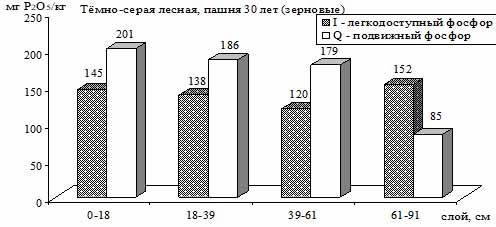
Results. The absorption and displacement of readily available and mobile phosphorus and their relationship with other soil properties in the gray forest soils and leached chernozems from various agrocenose were compared with the ones for their undisturbed counterparts. The undisturbed gray forest soil was found to absorb the largest amount of phosphorus, i.e. 200 and 600 kg of P2O5/ha, respectively. When the soil was used for 15 years in a vegetable agrocenosis without fertilizers, phosphorus mobility did not change, but the phosphate capacity decreased by 3 times. The dark gray soil, used for 30 years in a grain agrocenosis, absorbed on average 300 and 400 kg of P2O5/ha. In the leached chernozem, cropped for potatoes, the highest amount of phosphorus was in the NPK-fertilized soil, i.e. about 60 and 1100 kg of P2O5/ha, respectively, which can compensate for the removal of phosphorus by potatoes and have a lasting effect.
Conclusions. Increased mineralization of organic matter in the gray forest soil in the vegetable crop rotation reduced the mobile phosphate content by two times and did not affect the degree of phosphorus mobility, the value of which directly depended on the content of humus and calcium. In the dark gray arable soil of the grain agrocenosis, the amount and rate of phosphorus absorption were directly related to the humus content. pH value and the exchangeable bases and calcium content had significant impact on soil phosphorus absorption capacity.
Downloads
Downloads
Published
How to Cite
Issue
Section
License
Copyright (c) 2026 The Journal of Soils and Environment

This work is licensed under a Creative Commons Attribution 4.0 International License.